
If war ever reaches the Philippines, the law already spells out some of what happens next. Prices of basic goods such as rice, eggs and canned fish should be frozen automatically for up to 60 days in an area where a state of war is declared. Martial law is allowed only in case of invasion or rebellion, also for up to 60 days. Reservists can be called to active duty, and Filipinos in a country under Alert Level 4 will be ordered home. What the country’s disaster plans barely cover is war itself.
[VIDEO LINK]
At a Palace briefing on October 29, 2026, Presidential Communications Office Undersecretary Claire Castro said the government is ready for whatever might happen, according to a Manila Times report. The situations below are examples only; they name no country and predict no attack.
Who declares war
Only Congress can declare a state of war, by a vote of two-thirds of both the Senate and the House, voting separately (1987 Constitution, Article VI, Section 23(1)).
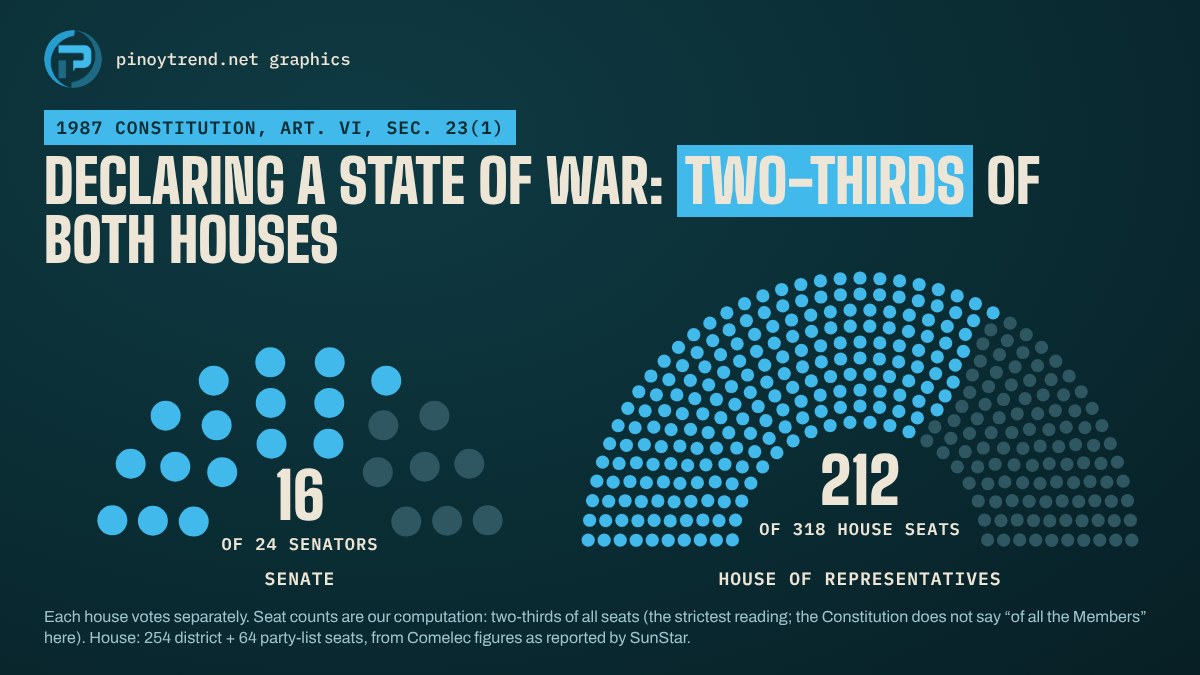
Counting all seats, that is 16 of 24 senators and 212 of 318 House members. These are our computations, done the same way for both chambers, and they use the strictest reading, since this clause does not say “of all the Members.”
Prices: an automatic freeze, unless the President says otherwise
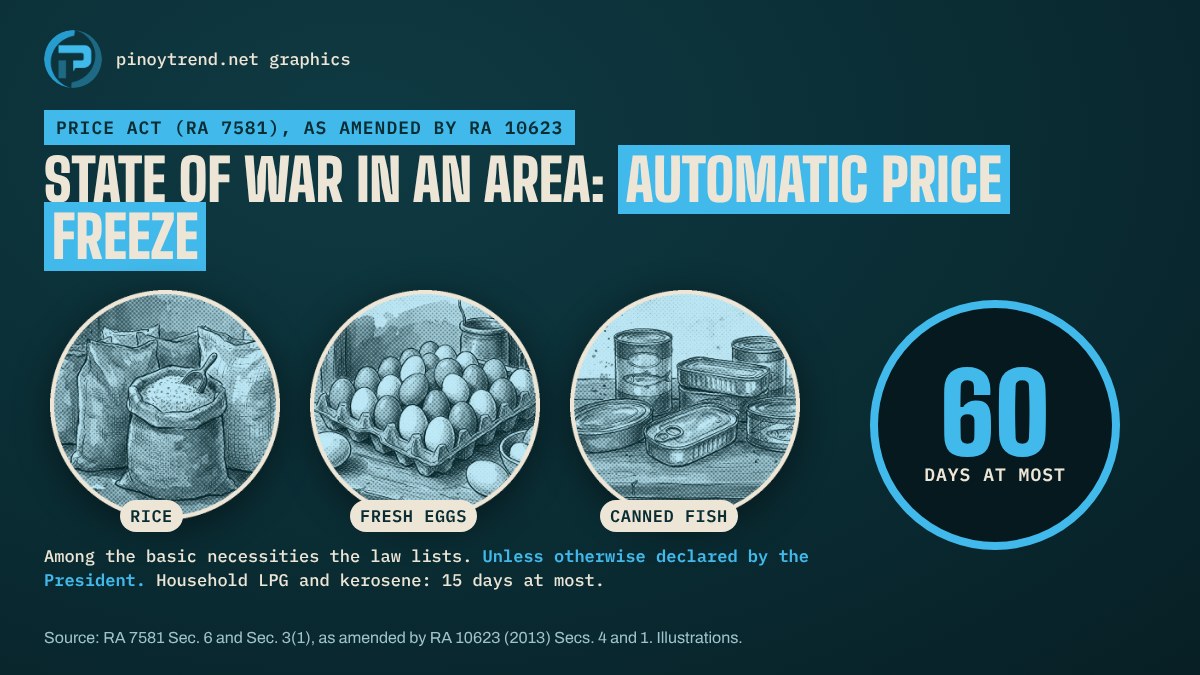
Under the Price Act (Republic Act 7581, as amended by RA 10623 in 2013), prices of basic necessities in an area are automatically frozen when “a state of war is declared in that area.” The law lists rice, “fresh, dried or canned fish” and fresh eggs among these basic necessities. The freeze lasts “not more than sixty (60) days,” or 15 days for household LPG and kerosene. It applies “Unless otherwise declared by the President.”
An emergency does not always bring a freeze. After President Marcos declared a national energy emergency on March 24, 2026, “in light of the ongoing conflict in the Middle East” (Executive Order 110), the Department of Trade and Industry (DTI) said that “an automatic nationwide price freeze under the Price Act (R.A. 7581) is not currently in effect,” according to a GMA News report. Instead, 21 major manufacturers “have formally pledged to maintain their current prices for the next 30 to 60 days.” So in an emergency, watch for whether DTI announces a price freeze.
Martial law has limits
The President may declare martial law only “In case of invasion or rebellion, when the public safety requires it,” for no more than 60 days (1987 Constitution, Article VII, Section 18). Congress may revoke it, or extend it “Upon the initiative of the President.” The Constitution stays in force, and martial law does not “supplant the functioning of the civil courts.”
Reservists and ordinary citizens
Under RA 7077 (1991), Section 59, full mobilization is “through the joint act of Congress and the President,” and reservists “are called to active duty.” The Constitution adds that “all citizens may be required, under conditions provided by law, to render personal, military or civil service” (Article II, Section 4).
For families of OFWs: Alert Level 4
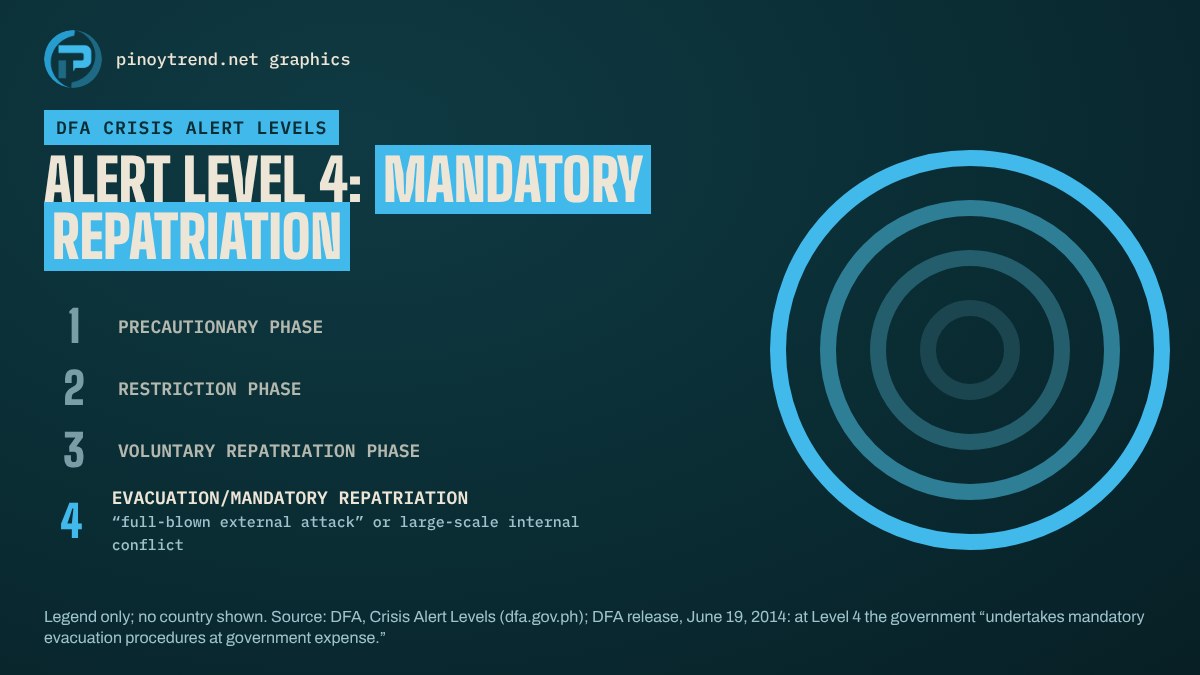
Of the Department of Foreign Affairs’ (DFA) four crisis alert levels, Level 4, “Evacuation/Mandatory Repatriation,” is issued when there is “large-scale internal conflict or full-blown external attack.” The government then “undertakes mandatory evacuation procedures at government expense,” the DFA has said.
For scale: Taiwan alone had more than 170,000 Filipino migrant workers in every month from October 2025 to September 2026, based on its Ministry of Labor. The end-September 2026 total of 190,798 is our sum of two columns, 169,651 in productive industries and 21,147 in social welfare. This is only an example of numbers, not a sign that any alert level has been raised there.
Civilians are protected by law
Under RA 9851 (2009), it is a war crime to intentionally attack “the civilian population as such or … individual civilians not taking direct part in hostilities,” or buildings for education, hospitals and similar places, “provided they are not military objectives.”
Is there a plan for you?
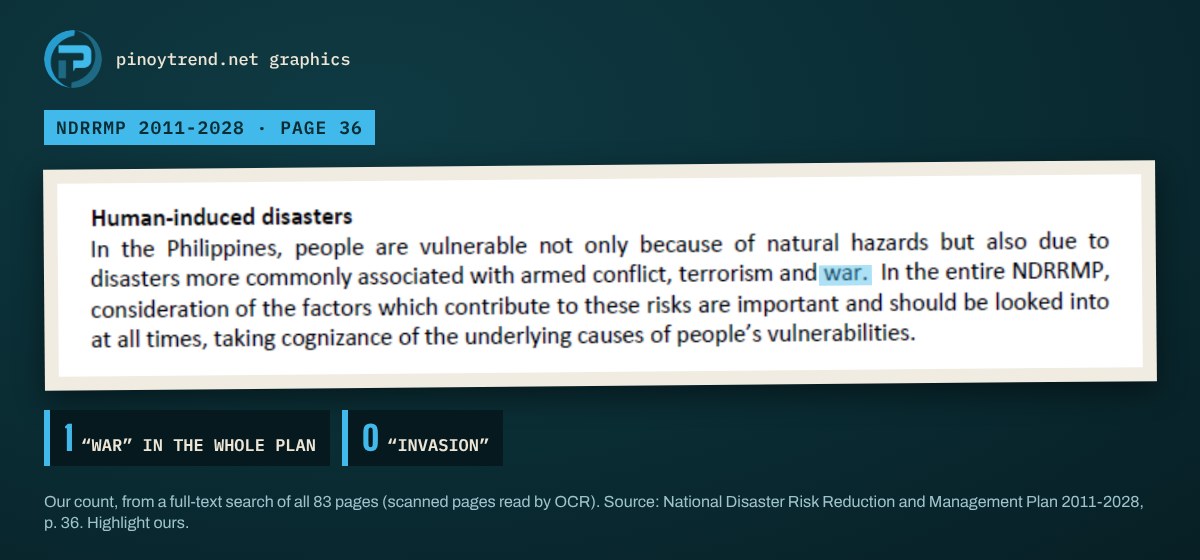
Not a specific one. The National Disaster Risk Reduction and Management Plan (NDRRMP) 2011-2028 mentions “war” once (page 36) and “invasion” never, based on our full-text search of all 83 pages. The armed conflict it discusses elsewhere is fighting inside the country (pages 8 and 12).
The newer NDRRMP 2020-2030 admits that drills focus “primarily on natural hazards” and that “Human-induced and biological hazards are seldom tackled leaving the local government and communities ill-prepared when such threats occur” (page 32). Its human-induced hazards include terrorism (page 9).
What you can do now: pack a go bag
The Office of Civil Defense (OCD) go bag list includes a flashlight, candle, matches and a whistle, a first aid kit with medicines, and “Ready to eat food and bottled water that can last for three days,” as reported by the Philippine Information Agency (PIA) in 2024. OCD Central Visayas adds extra clothes, hygiene supplies, important documents, power banks, extra batteries and cash, and suggests setting aside part of the canned goods you already buy. Check the bag every three months and replace items that will expire, the OCD says.
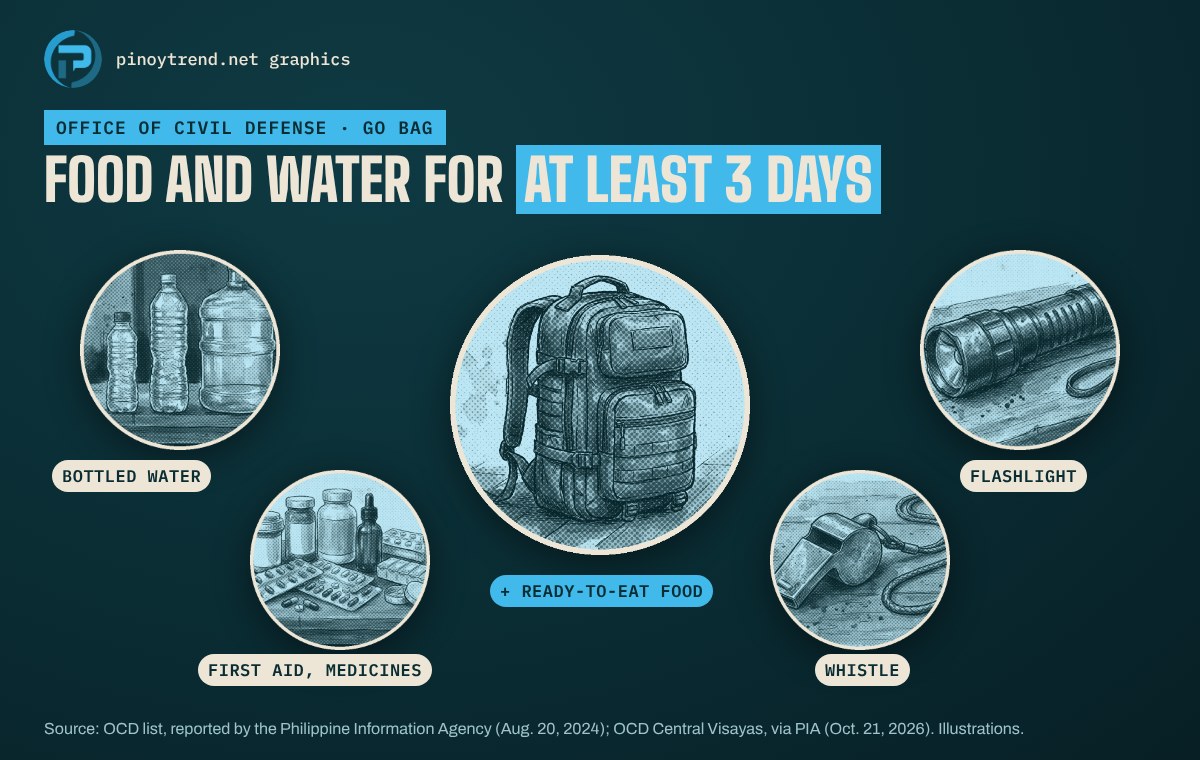
These steps help in typhoons and earthquakes too. And with luck, no one will ever need them for war.
Mga Resibo (Sources)
- 1987 Constitution, Article II, Section 4; Article VI, Section 23(1); Article VII, Section 18 (Lawphil copy).
- Republic Act No. 7581 (Price Act), Section 6 (Lawphil), as amended by Republic Act No. 10623 (2013), Sections 1 and 4 (Senate Legislative Digital Resources; Lawphil).
- Executive Order No. 110, s. 2026, Section 1, March 24, 2026.
- Republic Act No. 7077 (1991), Section 59.
- Republic Act No. 9851 (2009), Section 4(c)(1) and (10).
- Department of Foreign Affairs, “Crisis Alert Levels“; DFA, “DFA raises Crisis Alert Level 4 for Iraq,” June 19, 2014.
- Taiwan Ministry of Labor, Table 12-3, Foreign Workers in Taiwan by Nationality, October 2025 to September 2026 (the Philippine total is our sum of two columns).
- National Disaster Risk Reduction and Management Plan (NDRRMP) 2011-2028, pages 8, 12 and 36.
- NDRRMC and Office of Civil Defense, National Disaster Risk Reduction and Management Plan 2020-2030 (UN Women library copy), pages 9 and 32.
- Philippine Information Agency, “Civil Defense promotes ‘GO Bag’ for emergencies,” August 20, 2024 (OCD list).
- Philippine Information Agency, “Rice in soda bottles, cash in go bags: OCD shares low-cost disaster tips,” October 21, 2026 (OCD Central Visayas).
From news reports: DTI statement on no automatic price freeze, as reported by Ted Cordero, “No price freeze nationwide despite Marcos’ national energy emergency order,” GMA News, March 27, 2026, and “DTI: No price freeze,” SunStar Davao, March 29, 2026. Usec. Claire Castro’s remarks: Bernadette E. Tamayo, “Govt ready for any crisis – Palace,” The Manila Times, October 30, 2026. House seat count (254 district and 64 party-list seats): Comelec figures as reported by SunStar, September 18, 2025.
Graphics: Pinoytrend.net. Images marked as illustrations are illustrations, not photos.