
“Don’t panic.” That was President Ferdinand “Bongbong” Marcos Jr.’s message to the public on October 28, 2026, the day the peso fell to ₱63.991 per US dollar, its weakest on record. But ordinary Filipinos are already feeling the weaker peso in the price of diesel, electricity and groceries. So should netizens believe him?
Watch our video explainer on Facebook (in Filipino).
Almost ₱64 to the dollar
The Bangko Sentral ng Pilipinas (BSP) set the peso’s reference rate at ₱63.991 per dollar on October 28, 2026. That is the highest in the BSP’s daily record, which goes back to 1978. On December 29, 2025, the last trading day of last year, the rate was ₱58.805.

In a media interview in Muntinlupa City, the President said the peso weakened because of rising oil prices: “It is an effect of… the rising prices of oil, and subsequently the rising prices of fuel.” He added: “We have all the tools to defend the peso.”
Oil prices have surged since war broke out in the Middle East. The BSP itself said on October 22 (para. 2): “Renewed tensions in the Middle East have driven global oil prices higher.”
First: fuel, diesel and fares
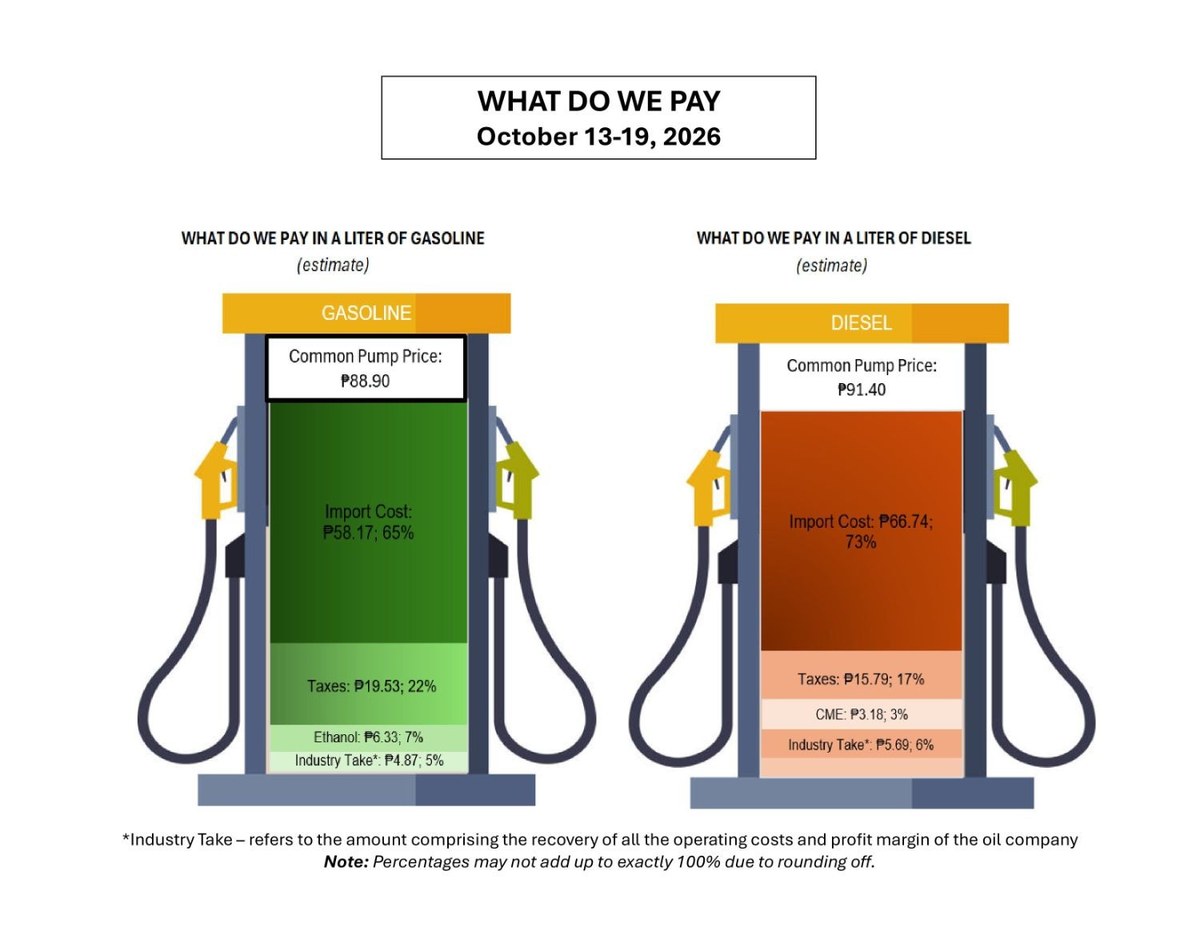
According to the Department of Energy (DOE), import cost made up ₱66.74, or 73%, of the ₱91.40 common pump price of a liter of diesel for October 13 to 19, 2026. For gasoline, import cost was ₱58.17, or 65%, of ₱88.90. Imported oil is paid for in dollars, so a weaker peso makes it more expensive in pesos.
Expensive diesel affects fares and the cost of moving goods. In the same BSP statement (para. 2), the central bank said: “Upside risks to inflation have materialized with the recent increase in transportation fares.”
Second: electricity
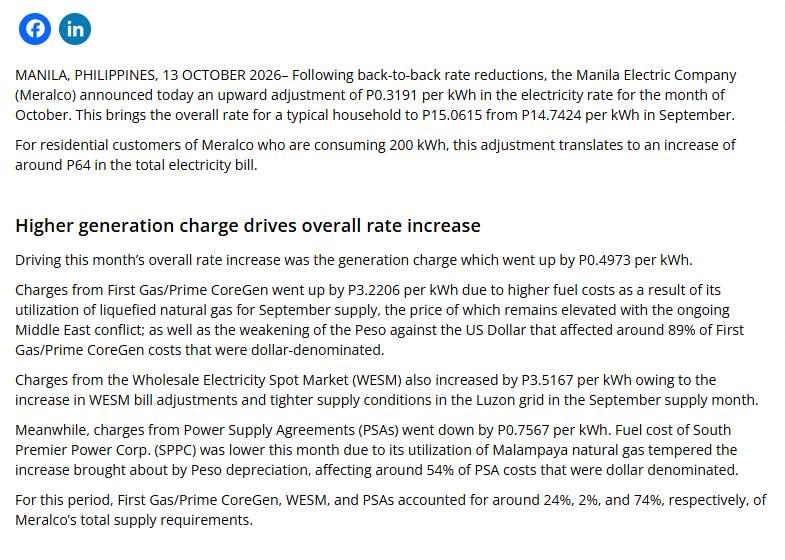
Meralco raised its rate by ₱0.3191 per kilowatt-hour (kWh) this October, bringing a typical household’s overall rate to ₱15.0615 per kWh, from ₱14.7424 in September. According to Meralco’s October 13 advisory, that adds around ₱64 to the bill of a household using 200 kWh.
The weak peso is one of the reasons. Meralco said the peso’s weakening affected around 89% of the costs of First Gas and Prime CoreGen, which are in dollars.
Third: the prices of goods
Imported goods cost more when the peso is weak. And as early as September, inflation had reached 7.2%, equal to April 2026 and the highest since March 2023, when it hit 7.6%, according to the Philippine Statistics Authority (PSA) as reported by PhilStar. Food was the main driver, so the peso is not the only reason prices are rising.
What about Christmas?
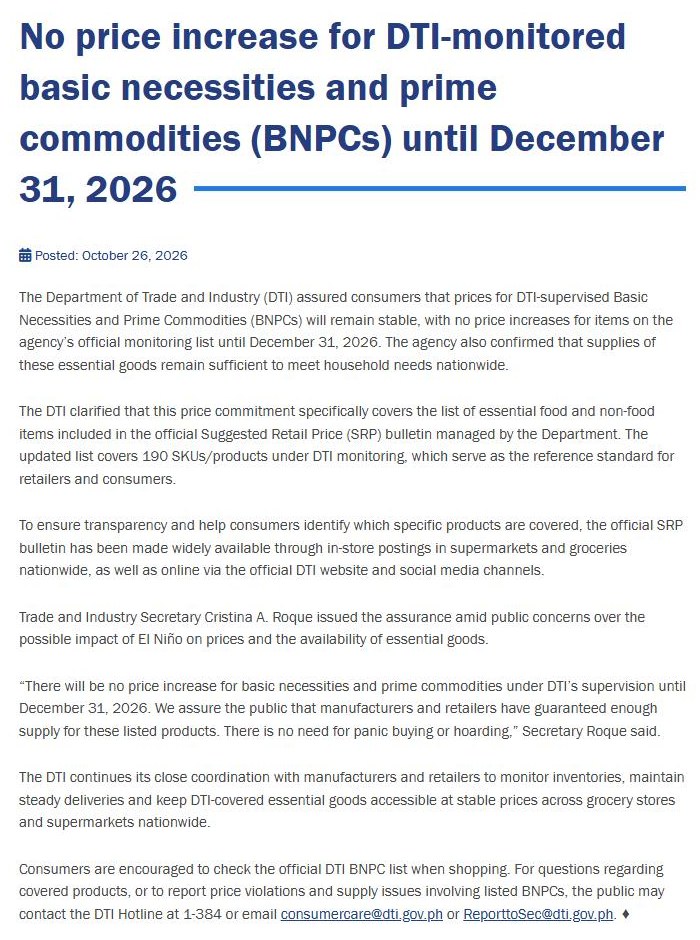
On October 26, the Department of Trade and Industry (DTI) announced no price increases until December 31, 2026, on the basic necessities and prime commodities it monitors. The promise covers the 190 products on the DTI’s Suggested Retail Price (SRP) bulletin (para. 2), including canned sardines, milk, 3-in-1 coffee, bread such as pandesal and Pinoy tasty, and instant mami noodles. The DTI gave the assurance amid concerns over El Niño’s effect on prices and supply (para. 4).
“There will be no price increase for basic necessities and prime commodities under DTI’s supervision until December 31, 2026. We assure the public that manufacturers and retailers have guaranteed enough supply for these listed products. There is no need for panic buying or hoarding,” Trade Secretary Cristina Roque said (para. 5).
But Noche Buena items are not on the list.
A boost for OFW families
A US$500 remittance is now worth ₱31,995.50 at the BSP’s October 28 rate, up from ₱29,402.50 on December 29, 2025, or about ₱2,600 more. Remittance centers use their own rates, so the actual amount received may differ. But prices are higher too.
Are the reserves really healthy?
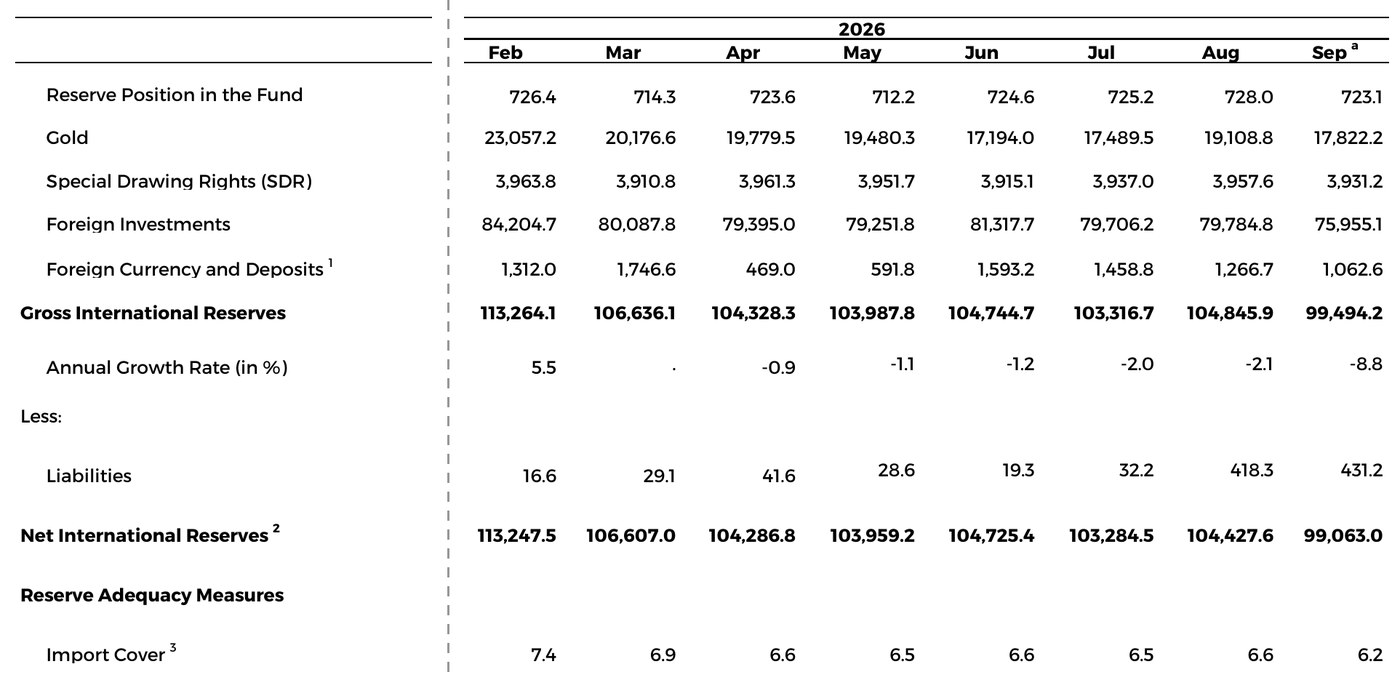
“Our foreign exchange reserves are healthy,” the President said. According to the BSP, the country’s gross international reserves stood at US$99.5 billion at the end of September 2026, enough to cover 6.2 months of imports of goods and payments for services and primary income. That is more than double the three-month benchmark cited by the International Monetary Fund.
But the reserves are falling. BSP data show they stood at US$113.3 billion in February 2026, when they covered 7.4 months of imports.
This is not 1997
During the 1997 Asian financial crisis, a dollar cost ₱26.40 until July 14, 1997. By January 8, 1998, it cost ₱45.42: the price of the dollar rose 72% in 178 days.
In 2026, the rate went from ₱58.805 on December 29, 2025, to ₱63.991 on October 28, 2026: a rise of 8.8% in 303 days. Both sets of figures come from the BSP’s daily record.
So, should we panic?
BSP data show the peso is weakening far more slowly, and by much less, than in 1997. The DTI also says there is enough supply of basic goods, so there is no need for panic buying.
But the weak peso is already being felt in fuel, electricity and prices. The BSP also raised its key policy rate to 5.50% on October 22 and expects inflation to accelerate further in the coming months (paras. 1 and 2).
For this Christmas:
- Plan your spending.
- Check the DTI’s price list before shopping. It is posted in supermarkets and on the DTI’s website and social media.
- Report overpricing to the DTI hotline 1-384 or to [email protected].
Mga Resibo (Sources)
- Bangko Sentral ng Pilipinas, Philippine Peso per US Dollar, Daily (full record since 1978): July 14, 1997; January 8, 1998; December 29, 2025; October 28, 2026.
- RTVM, “Media Interview at the 32nd National Correctional Consciousness Week,” Muntinlupa City, October 28, 2026.
- BSP, “Monetary Board raises Target RRP Rate by 50 basis points,” October 22, 2026, paras. 1 and 2.
- Department of Energy, What Do We Pay for a Liter of Fuel, October 13 to 19, 2026.
- Meralco, “Higher Residential Rates this October 2026,” October 13, 2026, paras. 1 to 4.
- Philippine Statistics Authority, Summary Inflation Report, September 2026, released October 6, 2026.
- Department of Trade and Industry, “No price increase for DTI-monitored basic necessities and prime commodities (BNPCs) until December 31, 2026,” October 26, 2026, paras. 2, 4, 5 and 7.
- DTI, SRP bulletin for basic necessities and prime commodities, effective May 11, 2026.
- BSP, “GIR settle at US$99.5B, BOP posts US$3.1-B deficit in Sept 2026,” October 19, 2026.
- BSP, International Reserves (Table 4), February and September 2026.
- International Monetary Fund, Assessing Reserve Adequacy, February 14, 2011.
From a news report: Renalyn Ramirez, “Philippine inflation jumps to 7.2% in September 2026,” PhilStar, October 6, 2026 (on source no. 6).
Photos: RTVM (Oct. 28, 2026). Screenshots from the BSP, DOE, Meralco and DTI.